






A stray dog we’ve befriended, allowing him to sleep in our garage at night when the weather was inclement, came back to our property one night and I could see in the dark something was wrong when I took his meal to him. I brought him into the garage and saw he had a huge deep gash from one side of his nose across to the other lip. I fetched a bowl of water and wiped the blood off so I could see what I was dealing with and it was bad, really bad. He likes to chase anything with moving tyres so I presumed he’d been hit by a car until I found a perfect hole in his upper neck, so deep I could see into the cavity of his throat when I shone a torch on it, realising then he’d been gored by a wild boar. We live in the middle of nowhere in northern Spain and even if I’d ever managed to find a decent vet, let alone master Spanish to fully communicate, who would do what just I ask and not battle with me over antibiotics et al, I still wouldn’t have taken him to be stitched up—I had no idea if this dog has ever been in a car before, now was not the time to try.
He really needed stitches so for the first few days I kept packing his wounds with crushed Yarrow leaves (the Battlefield herb) that I was macerating in my own mouth (free of the mind program of bacteria being evil and causes infection), to try to glue together the gaping holes, giving him lots of protein to eat, and keeping him still in the garage, except for a daily lead walk. On day 2 he was still in shock, thankfully I did not experience a DHS from his emergency. I’m not particularly squeamish but his nose injuries were so bad I struggled to even look at them. On day 3 he was more himself again but he stank of rotting flesh which lasted for 9 days—the smell became so intense it was difficult to be around him—but was a welcome sign that his brain had sent the symbiont bacteria to work on his injuries. As extreme as the malodorous wounds were I had no fear of infection because of Hamer’s 4th biological law, and comfort in the knowledge that injuries also cause a brain edema, which launches the healing phase.
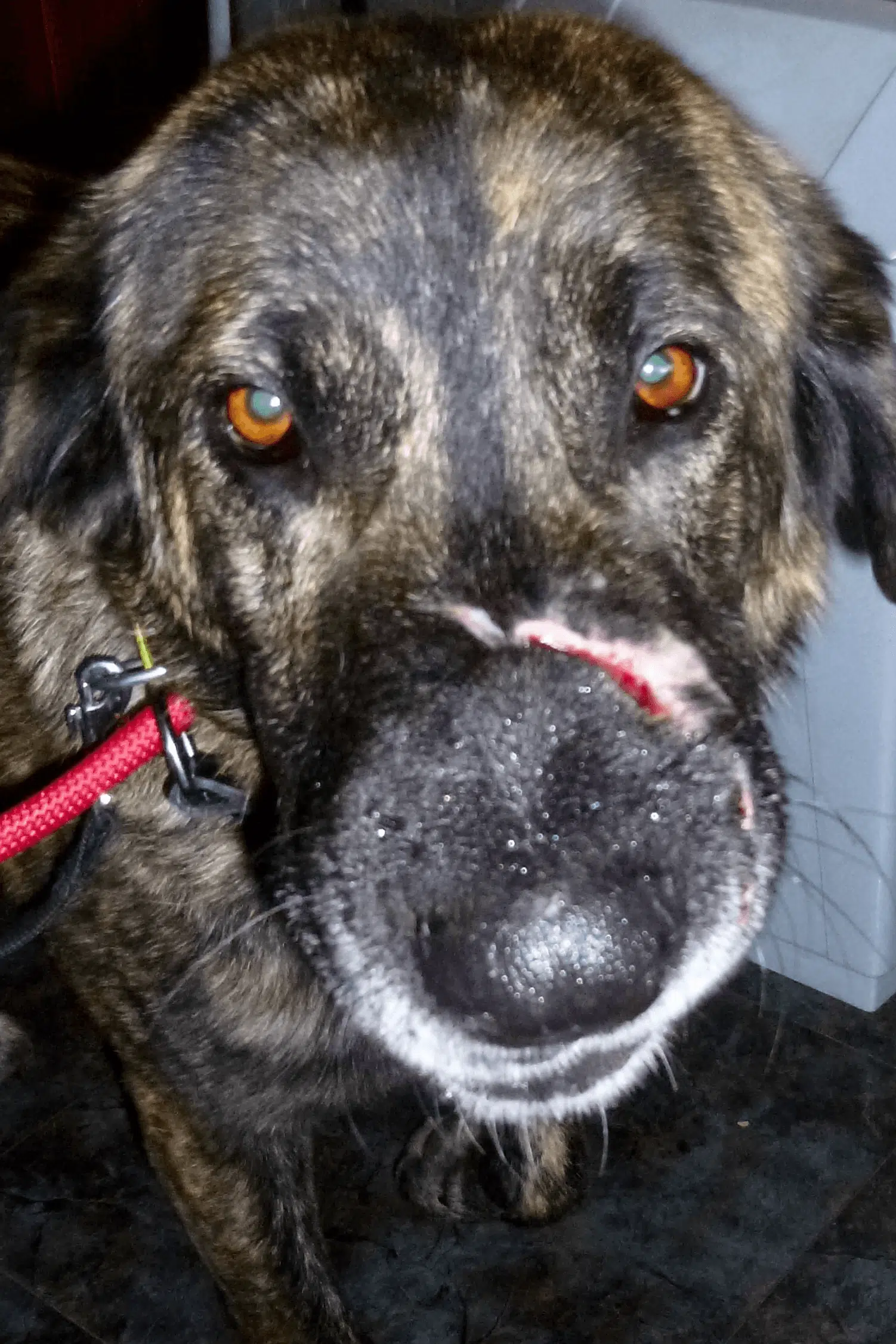
The entire event took 3.5 weeks. However, because he started trying to clean his nose wound (and I thought the puncture hole in his neck was going to be the problem) with his massive paws he pulled off a huge flap of nose skin off right in front of me, which I shoved back in the wound—now I could see the bone—resulting in my giving him 24hr care inside my kitchen/sitting room, changing muzzles twice a day that I was sewing bandages into in order to protect his nose from himself, and ‘sleeping’ on the sofa to ensure he didn’t get the muzzle off unsupervised, or escape over the fence, which he did twice.
Four weeks later he had another, even worse injury, this time I believe from chasing a car. There was no point in using Yarrow this time, his wounds were too extreme: he had a deep hole next to his eye with a ravine down to the same lip as his previous wound; the lip was split in 3 places, each split was 6-8cm long. I did the same routine, kept him sedentary in the garage, fed him protein only, and lead walks each day. The smell of carrion came on just as strong on day 3 again, and even though I felt somewhat helpless to be proactive with his injuries this time, I was comforted by my comprehending and living Hamer’s life changing discoveries. Lord Bryan (his given name), is absolutely fine now, albeit disfigured—he now looks like the Batman Joker on his left side.
Again and again, one observes dogs that are impossible to hold back as soon as something moves quickly past them. Cyclists know what I am talking about.
Like humans, animals are also subject to certain instincts that are meant to ensure their survival. The hunting instinct may be important for a predator in nature. But even more important should be the self-preservation instinct – that is, the instinct that prevents an animal from taking on significantly larger and superior opponents, for example cars or, as in this case, wild boars. Even bears avoid wild boars when they have young.
It is certainly due to various conflicts and constellations when a dog’s hunting instinct completely overrides its survival instinct – but that is not the subject of this testimonial.
We humans have been conditioned to have no trust whatsoever in our body’s self-healing powers. We run to the emergency room for every scratch. Unfortunately, we usually do the same with our pets. But as the example of this suicidal dog shows, even large, gaping wounds heal without medical help. The human body also possesses the same self-healing powers as this dog.
The spleen alters the blood coagulation factor so that bleeding stops after the wound has been “washed out.” Fungi and mycobacteria begin to break down dead tissue, and bacteria start to repair the tissue. All the body needs is a quiet, protected place where the patient can retreat to calmly allow his body to heal the wound.
Not every wild animal is lucky enough to find a human who also provides it with food and emotional support – that is of course the optimum.
A few years ago, I also split open my fingertip so badly that the bone was visible. Having my finger treated medically was not an option at the time due to the mask requirement in medical facilities. So I taped the fingertip back into the correct position with a bandage and trusted that my body knew what to do. Today, only a small scar reminds me of the incident.
I wish the dog a quick and sustained recovery and thank the author for writing down her observation for us.